
Speech Timing Rescue Kit
The calculator says your speech is too long. Now what?
A 20-minute rescue, not a course. This printable and editable workbook tells you exactly what to cut, how to rehearse with live checkpoints, and how to land on the clock.
7-day money-back guarantee. If it does not help you cut your speech, email us for a full refund.
The PDF and DOCX are built. The checkout link is the remaining setup step.
What you get
The kit turns a vague timing problem into a few concrete numbers: your real expected time, the gap to the limit, the words to cut, and the checkpoints that tell you whether the speech is safe.
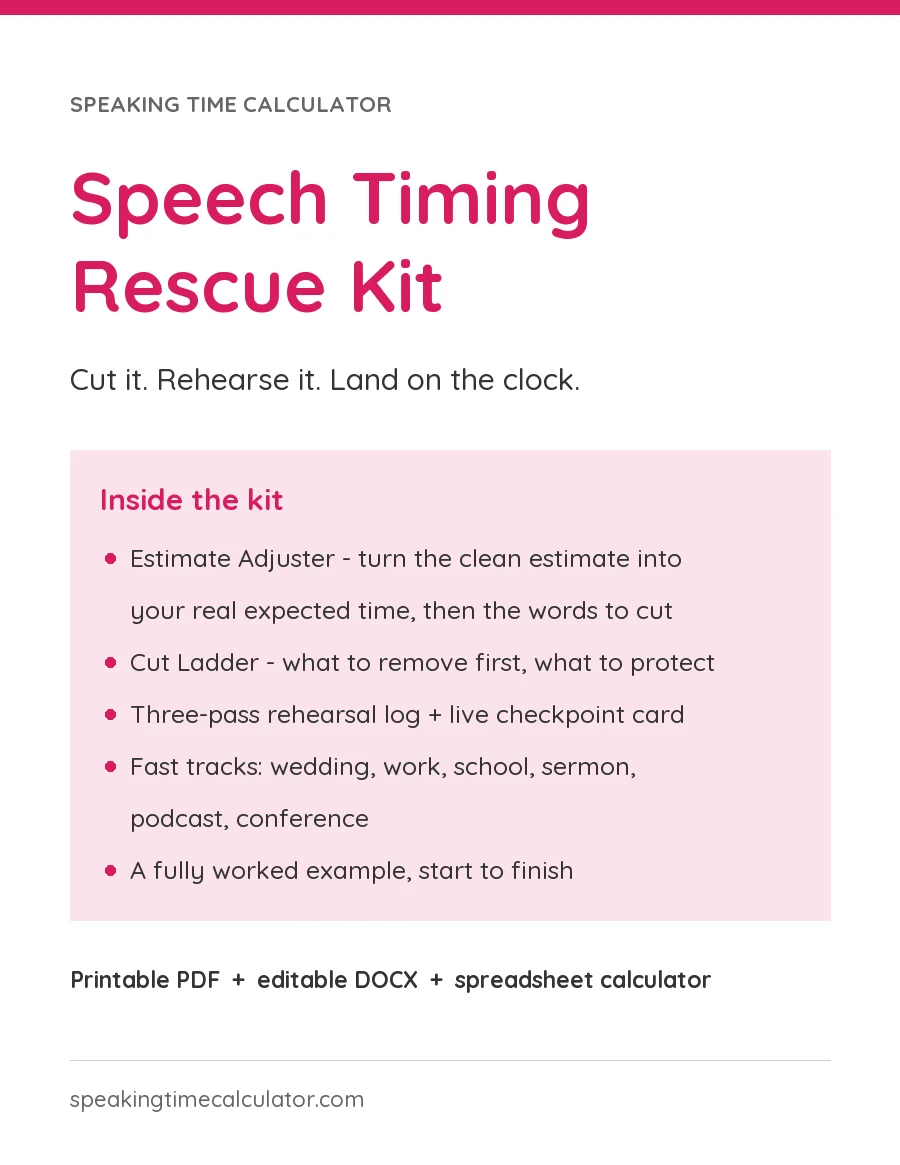
Inside the workbook
Find your real number
Add the live tax for pauses, laughs, breath, and ad-libs before you start cutting.
Cut ladder
Protect the spine, keep the muscle, and remove the fat without sanding off the point.
Rehearsal log
Run three out-loud passes with checkpoints so you know where the speech drifts.
Fast tracks
Use short timing notes for wedding toasts, work updates, school talks, sermons, podcasts, and conference talks.
Use it tonight
- Paste the draft into the calculator and write down the clean estimate.
- Add 15-20% for the room, then compare that number with your hard limit.
- Use the cut ladder to remove whole examples, repeated thanks, and setup before line editing.
- Rehearse out loud and mark a live safety section you can drop if time runs tight.
Know the number, not just the bad news
The calculator counts words. It cannot see the room. The workbook's Estimate Adjuster turns its clean estimate into your real expected time, then tells you exactly what to cut.
- A. Calculator estimate
- B. Live tax for pauses, laughs, breath, and ad-libs (add 15-20%)
- C. Your real expected time (A + B)
- D. Your hard time limit
- E. The gap (C minus D)
- F. Words to cut (the gap in minutes × your speaking rate)
A fully worked example runs the whole kit on a real 7-minute toast cut to 4:30, so you see what "done" looks like before you start.
Before you buy
Can't I just ask ChatGPT to shorten it?
AI does not know where you breathe, where the room laughs, or how fast you speak when nervous. This calibrated toolkit shows you what to cut and builds a real-world buffer.
It is only 9 pages?
It is a rescue kit, not a textbook. Every page is a worksheet you fill in, and the Emergency 5-Minute Trim fits on one page because you will use it the night before.
Will it fit my type of speech?
The workbook includes fast tracks for wedding toasts, work updates, school talks, sermons, podcasts, and conference talks.
Is a PDF worth it?
You get a fillable PDF and an editable DOCX, plus a worked example. Type into it or print it. It is backed by a 7-day money-back guarantee.
Free 1-page checklist
The short version is below. The full workbook turns each step into a fill-in worksheet.
Free Preview: Speech Timing Rescue Checklist
Your speech is too long. Here is the short version of how to fix it tonight. Share this freely.
Find Your Real Number
The calculator counts words. It cannot see you. Take its estimate and add 15-20% for pauses, breath, laughs, and the sentences you will ad-lib in the room. That bigger number is what you are actually fighting. You speak roughly 130 words a minute out loud, so over by two minutes means cut about 260 words. Now you have a target, not a feeling.
The 5-Minute Fix
- Write the official time limit, then a private target 5-10% shorter.
- Find the section that uses the most time.
- Cut whole things, not words: one example, one setup paragraph, one repeated point - before you touch the main message.
- Read it out loud, standing, once. Silent reading is about twice too fast and tells you nothing.
- Mark one section you can drop live without anyone noticing. That is your safety valve.
Cut These First
- Throat-clearing opener.
- Repeated thanks.
- Calendar backstory.
- Third example (one strong example beats three similar ones).
- Caveat stack.
- Slide-reading.
- The second ending after the real ending.
Keep These
- The one sentence that says what the speech is really about.
- The story or example that makes the audience care.
- The transition that prevents confusion.
- The final line, if it is short and memorable. Memorize it - it is the only part the room remembers.
If this checklist helped, the full Speech Timing Rescue Kit turns each step into a fill-in worksheet: an estimate adjuster, a section budget, a cut ladder, a three-pass rehearsal log with a live checkpoint card, nerves and pause adjustments, and fast tracks for wedding toasts, work updates, school talks, sermons, podcasts, and conference talks. Printable PDF plus editable DOCX.